You Haven't Missed the AI Window - Here's Where to Start
Everyone's talking about AI, and yet most people using it daily still feel like they're missing something. The tools keep multiplying, the acronyms keep coming, and the feeling of being behind never quite goes away. Let me tell you why that feeling is wrong.
INSIGHTS
6/7/20266 min read
Everyone's talking about AI. You're nodding along, using ChatGPT for the occasional email rewrite, maybe sitting through a company demo of some new tool. And yet — there's this nagging feeling that you're only scratching the surface. That this technology has so much more to offer. That every morning you wake up to ten new tools, ten new acronyms, and somehow the gap between where you are and where you "should" be keeps widening.
Sound familiar? Let me tell you why that feeling is lying to you — and what to do instead.
It Wasn't Always This Easy
My first contact with AI was in the early 2000s, when I attended a university seminar on neural networks as an Engineering Physics student. Not because it was career-relevant — it wasn't, not yet. Because it was fascinating. The handful of researchers working on it were talking to each other, not to the business world. Nobody felt behind on AI because almost nobody had heard of it - and even for physics and engineering students, it was seen as some mysterious dark art.
Fast forward to my MBA at Carnegie Mellon, around 2018-2019. I adventured into taking a couple of hard-core Machine Learning courses at the CS department — and I mean hard-core. We had to build backpropagation algorithms from scratch in Matlab, before we were allowed to touch a Python library that would magically train a model and run an inference in just a couple lines of code. We were thrilled to produce regression models that estimated house prices, or classifiers that recognized handwritten digits. That was the cutting edge of what most practitioners were doing.
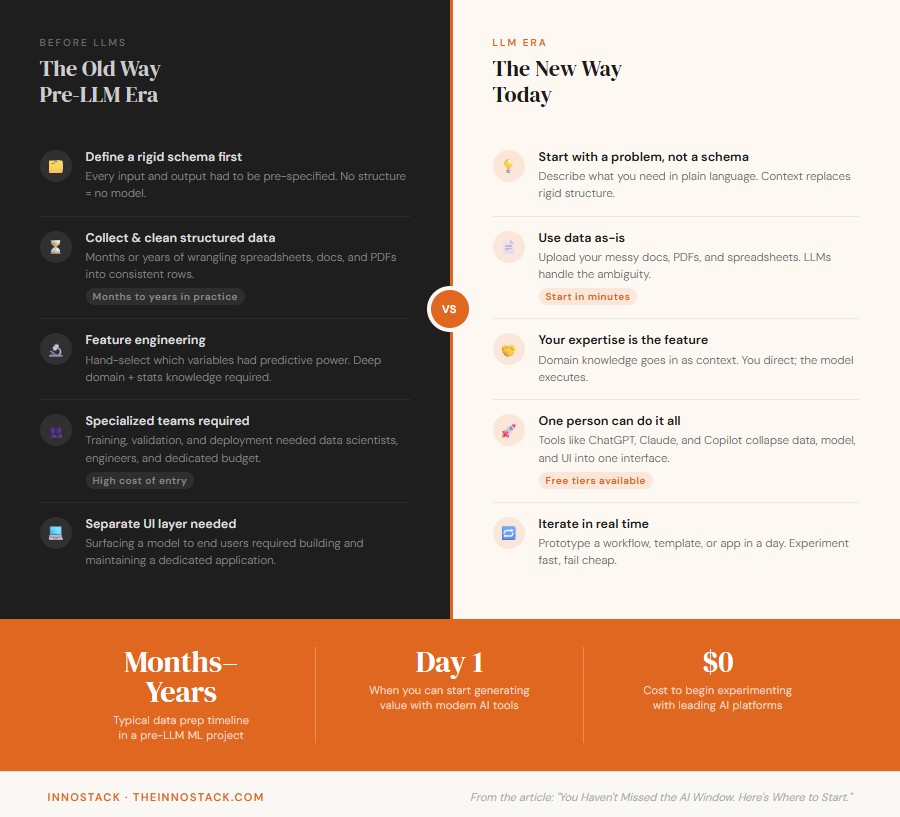
Then came my first real AI project at work, around 2017. Me and my cost manager had a straightforward idea: use historical bid data to predict project costs. What followed was nearly two years of collecting and cleaning data scattered across Word documents, Excel spreadsheets, PowerPoints, and PDFs — each in slightly different formats, with templates that had changed every few years. Pre-LLMs, you couldn't just hand the model your data. You had to force everything into a rigid, perfectly structured schema first. No ambiguity tolerated.
After that came feature engineering, a proof-of-concept phase, a data science team, and an IT team to build the application on top of the model. The project was a success — it's still running across multiple sites and countries today. But the point is what it took to get there.
That was the price of admission. A specialist team, a real budget, and two years before you had anything to show for it.
Today, one person can start in an afternoon. For free.
Why the Barriers Are Gone — And What That Means For You
The rise of Large Language Models — and the ecosystem of tools built around them — has fundamentally changed what "starting an AI project" looks like. The new models don't need perfectly structured, labeled datasets to be useful. They understand context, reason through ambiguity, and work with messy, unstructured inputs that would have made a 2017 ML engineer cry.
You don't need a data science team. You don't need two years of data prep. You don't need to know what backpropagation is.
What you do need is a problem worth solving, some curiosity, and the willingness to experiment.
Where to Start: A Few Tips That Actually Help
These aren't steps in a strict sequence — think of them as independent levers you can pull, in whatever order makes sense for where you are right now.
Take stock of what's already available to you at work
Before you start building anything, find out what AI tools are already deployed in your organization. Many large companies have already rolled out Microsoft Copilot, Google Workspace AI, or similar — and most employees barely use them beyond the basics.
Push beyond the "summarize this email" use case. Can you synthesize a 40-page report into a decision brief? Draft a stakeholder communication in three different tones? Analyze patterns in a spreadsheet you've been ignoring for months?
If your organization has little to nothing available, that's actually an opportunity. Do the research, build the business case, and propose something. Business leaders today are hungry for AI adoption — if yours isn't, that may be worth reflecting on.
Build a personal AI practice — don't wait for permission
The best way to learn is through real projects, and you don't need work to give you the green light. Pick something you actually care about. A few starting points:
Knowledge management — Use an AI tool (Notion AI, ChatGPT, Claude) to organize your notes, reading list, or professional learnings into a structured knowledge base.
Content creation — If you write articles, presentations, or proposals, use AI as a drafting and editing partner. Compare what it produces with what you'd have written alone.
Data analysis — Have a spreadsheet you've been meaning to dig into? Upload it and have a conversation with it.
Automation — Identify one repetitive task in your work or personal life and experiment with automating it, even partially.
Most of these tools have free tiers. The goal isn't to build something impressive — it's to build your intuition for what AI can and can't do.
Reframe "replacement" as "augmentation"
If you're worried about AI replacing your job, here's the most useful reframe I can offer: the people who get replaced by AI won't be those who use it. They'll be the ones who refused to.
But more importantly — there's a lot that only humans can do. Listening to a colleague who's frustrated and figuring out what they actually need. Walking into a room and reading the political dynamics before you open your mouth. Inspiring a team through uncertainty. Earning trust over years of showing up. Getting buy-in from a skeptical executive by knowing exactly which lever to pull.
AI cannot do any of that. Lean into those skills harder than ever, and let AI handle the rest — the synthesis, the first drafts, the pattern recognition, the repetitive formatting.
The formula isn't you vs. AI. It's your expertise + human judgment + AI processing power. That combination is genuinely hard to beat.
Use AI to break your own patterns — not just speed them up
Here's something I didn't expect when I started using AI more seriously: it's not just faster — it's different.
The most valuable thing AI has done for my work isn't saving time. It's breaking patterns. Asking an AI to challenge your approach, suggest alternative structures, or pressure-test your logic gives you a thinking partner that has no political stake in the outcome. It will tell you your framework has a gap. It will suggest a way of organizing information you hadn't considered.
In a modern workplace where experimentation is increasingly the competitive advantage, AI is the ultimate rapid prototyping tool. New template? Test it in an hour. New workflow? Map it out and simulate edge cases. New internal application? Build a working prototype in a day, at speeds that would have been unthinkable two years ago.
Use it to experiment fast, fail cheap, and learn continuously.
Find your people
Learning AI in isolation is slower and lonelier than it needs to be. Find the people around you who are curious about the same things — they're usually easier to find than you'd expect. Share what you're experimenting with, ask what they're using, trade failures and breakthroughs.
If you're in a larger organization, consider proposing a Special Interest Group or Employee Resource Group around AI and innovation. These communities surface use cases you'd never have thought of, create psychological safety to experiment, and often end up with a direct line to leadership on transformation initiatives.
Pick one thing, build from there
LLMs. Agents. RAG. MCP. Prompt engineering. Fine-tuning. Vector databases. Agentic workflows. Multimodal models.
The terminology expands weekly, and it's easy to feel like you need to understand all of it before you can do anything useful. You don't.
Pick one thing just beyond your current comfort zone. Find a real, practical application for it. Do it. Then pick the next thing.
Build your "AI portfolio" one project at a time — a collection of real things you've built, automated, improved, or learned from. That portfolio compounds. In a year, looking back, you'll be surprised how far you've come.
The goal isn't to know everything about AI. The goal is to keep moving.
The Bottom Line
I started learning about neural networks when they were considered fringe science. I spent two years gathering data for an ML project before I could write a single line of model code. I've watched the field go from niche academic curiosity to the most consequential technology shift of our lifetimes.
And here's what I can tell you with confidence: you have not missed the window.
In fact, in many ways, right now is the best possible time to start. The tools are mature enough to be genuinely useful, the learning resources are abundant, and most organizations are still figuring out how to use this well. That's not a threat — it's an opening.
The only real risk is waiting.
So: what's your first project going to be?
Have a project in mind or an experience to share? I'd love to hear about it — reach out via the contact page or connect on LinkedIn.
InnoStack
Bridging the gap between technical knowledge and product vision.
Empowering leaders to build what matters.
Quick Links
© 2025. All rights reserved.
Let's collaborate
Stay tuned !
Subscribe for the latest insights and resources