The Bottleneck Isn't the AI. It's What You Feed It.
Why knowledge management — not model capability — is the skill that separates people who get real leverage from AI and people who get plausible-sounding noise.
INSIGHTS
7/6/20265 min read
Here's a pattern I keep seeing, in my own work and in every team I talk to.
Someone asks an AI a serious question — draft this proposal, analyze this decision, summarize where this project stands. The answer comes back fast, confident, and well-written. And because it sounds right, it's tempting to take it and run.
Sometimes that works. But often the answer was built on the wrong context: a generic assumption instead of your actual constraint, last quarter's numbers instead of this quarter's, an invented detail filling a gap you didn't know existed.
The uncomfortable truth: the models are no longer the bottleneck. You are — specifically, what you feed them.
Capability is solved. Context isn't.
Today's frontier models can process, analyze, synthesize, and write at a level that would have seemed absurd three years ago. Capability is, for most professional purposes, a solved problem.
What's not solved is whether the model is working from the right inputs. When MIT's NANDA initiative studied enterprise generative AI pilots, it found 95% failed to deliver measurable ROI — and the cause wasn't model quality. It was what the researchers called the "learning gap": the tools don't know your workflows, your history, your constraints, and organizations never close that gap.
Andrej Karpathy — who helped build the current AI wave and recently joined Anthropic — describes the core skill as context engineering: "the delicate art and science of filling the context window with just the right information for the next step."
Notice what that implies. The leverage moved from prompting cleverly to supplying the right knowledge. And supplying the right knowledge, repeatedly and efficiently, has a name we've had for decades: knowledge management.
The queryable professional
The gap shows up in the enterprise data too. A 2026 Harvard Business Review Analytic Services study found that 94% of organizations say well-connected data, processes, and applications are critical to successful AI adoption — but only 27% say those elements are actually well-connected today. That gap between "important" and "in place" is exactly what separates the companies compounding value from AI and the 95% MIT found aren't.
Some practitioners describe the extreme version of closing that gap as making a company "fully queryable" — every decision, metric, and document structured so AI can answer questions about the business on demand. That's usually framed as a founder's problem.
But the idea scales down beautifully — and that's where most of us actually live. You don't need to be building a startup to become a queryable professional: someone whose work — decisions, meeting outcomes, domain knowledge, project history — is captured and structured so AI can use it on demand, instead of guessing.
Think about what's currently locked in your head or scattered across inboxes:
Why you chose vendor A over vendor B, and what constraint drove it
What was actually agreed in last Tuesday's meeting (not what the vague recap email said)
Your competitive landscape, your pricing logic, your team's unwritten rules
The financial model behind that business case you defend every quarter
Every time you ask AI for help without this context, you're forcing it to improvise. Improvisation is where hallucination lives. When I deployed my first machine learning model in production back in 2017, the lesson was the same one that applies now: the model was never the hard part. The data pipeline was.
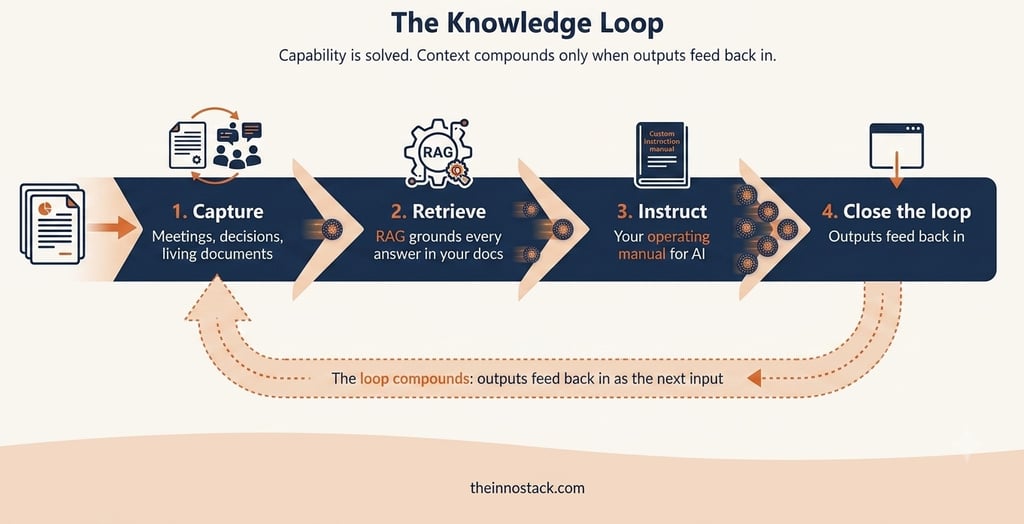
Step 1: Capture — stop starting from scratch
The foundation is boring and unglamorous: start collecting and saving your working knowledge in a form AI can read.
Meetings: record and transcribe them. Turn transcripts into minutes and decision logs. This alone changes what AI can do for you on any ongoing project.
Living documents: one document per domain that matters — project context, financials, competitive intel, team norms. Not perfect, just current.
Decisions: a simple running log. What was decided, when, why, by whom.
Tiago Forte's Building a Second Brain gave us the pre-AI blueprint here — Capture, Organize, Distill, Express — and he's since reworked the whole method around AI. The shift is important: you used to build a second brain so you could retrieve things. Now you build it so AI can.
The organizing principle: capture once, reuse forever. Blindly re-explaining your situation in every new chat is the AI equivalent of retyping a document instead of saving it.
Step 2: Retrieval — make the knowledge reachable
Captured knowledge only helps if the AI can actually reach it at the moment of the question. That's what retrieval-augmented generation (RAG) does: instead of relying on training data, the model searches your documents first and grounds its answer in what it finds.
You don't need to build RAG yourself. Every major platform now ships a consumer version of it:
Claude Projects — upload your living docs into a project; every conversation in it starts grounded in that knowledge base. Strongest for large reference bases.
ChatGPT Projects + Memory — per-project files and instructions, plus memory that accumulates what it learns about you over time.
Gemini Notebooks / NotebookLM — grounded workspaces that reason only within the sources you provide, tightly integrated with Google Workspace. NotebookLM in particular refuses to stray from your documents — useful when you want zero improvisation.
The tool matters less than the habit: your living documents go in, and stay updated. A knowledge base that's six months stale is just a more confident way to be wrong.
Step 3: Custom instructions — your operating manual
Documents tell AI what you know. Custom instructions tell it how to work with you. This is the step most people skip, and it's where output quality jumps.
Your instructions should encode things like: your role and audience, your standards ("cite the source document for any number you use"), your guardrails ("if the knowledge base doesn't cover it, say so — don't fill gaps"), and your format preferences.
That last guardrail is your primary anti-hallucination control. An AI that's explicitly told to flag missing context is dramatically more trustworthy than one left to be maximally helpful.
Write the instructions once, refine them as you notice failure patterns, and reuse them across every project. It's an operating manual for a very capable new team member — which is exactly what this is.
Step 4: Close the loop
Here's where it compounds. In Blomfield's framing, the difference between open-loop and closed-loop systems is whether outputs feed back in.
Open loop: you ask, AI answers, the answer dies in the chat. Next week you ask again from scratch.
Closed loop: the useful outputs — the meeting minutes, the updated analysis, the decision memo — get written back into your knowledge base. The next question starts from a richer foundation than the last one. Your system gets smarter with use.
Karpathy recently sketched a pattern he calls the LLM wiki: a structured set of documents the AI itself reads and maintains — updating pages as work happens, so the knowledge base becomes a living memory layer rather than an archive. You can run a lightweight version of this manually: end each significant AI session by asking, "update the project doc with what we decided today."
Closing the loop requires housekeeping, and this is genuine work: retire stale documents, correct errors when you catch them, prune what no longer matters. Feedback loops amplify whatever's in the system — including mistakes. Curation is the price of compounding.
Start this week: record one meeting
If this whole system sounds like a lot, ignore the system. Do one thing:
Record your next meeting. Transcribe it. Have AI turn the transcript into minutes with decisions and action items. Save that into a project folder in your AI tool of choice.
That's the seed. Next meeting, add another. Within a month you'll have a project knowledge base that answers questions no fresh chat ever could — "what did we commit to the client in March?" — instantly, and grounded in what actually happened.
The professionals who pull ahead in the next few years won't be the ones with access to better models. Everyone has the same models. They'll be the ones who built the better inputs — who made themselves queryable, closed the loop, and let the system compound.
The AI is ready. The question is whether your knowledge is.
***
Sources & further viewing: Tom Blomfield — How to Build a Self-Improving Company with AI · Diana Hu — How to Build a Company with AI from the Ground Up · Anthropic — Effective Context Engineering for AI Agents · MIT NANDA — The GenAI Divide · Tiago Forte — The AI Second Brain
InnoStack
Bridging the gap between technical knowledge and product vision.
Empowering leaders to build what matters.
Quick Links
© 2025. All rights reserved.
Let's collaborate
Stay tuned !
Subscribe for the latest insights and resources